A men's spine tattoo is built like a single line. It starts at the base of the neck or between the shoulder blades, runs down along the bone and has to stay straight when you move. On a broad back, this narrow band down the centre creates a strong contrast: a clean, vertical piece that gives the whole back its structure. Here are 24 black-line ideas, sorted by style: vertebrae, tribal, Japanese, blades, geometry, lettering and minimalist. They are followed by tips on placing the design and testing it. To try a design on your skin before you commit, discover our spine temporary tattoos.
Men's vertebrae tattoo: the spine, drawn out


The most direct idea is to draw what lies beneath the skin. Stacked vertebrae make a piece that is vertical by nature, already divided into regular segments. Each element repeats the one before, and the eye follows the line effortlessly.
The four designs in this section treat the idea in different ways. The biomechanical vertebrae replace bone with metal parts, pistons and bolts, shaded in solid black. It is the most graphic look, and it takes up the full height of the back. The ornamental vertebrae go the opposite way: each segment becomes a piece of filigree, with scrolls that barely stray from the axis. The engraving-style vertebrae, shaded with stippling, stay close to anatomy, like an old plate from a medical book. Finally, the snake skeleton keeps the chain of vertebrae but makes it undulate, with a small skull at the top and a tapered tail at the bottom.
With these designs, regularity matters more than detail. A segment wider than the others is spotted straight away. Centre the first segment on the axis, then check the alignment in a mirror, with your back to it and your arms by your sides: in that position, the line should fall straight.
Want to see a vertical piece on your skin? These designs from our collection are available as temporary tattoos:








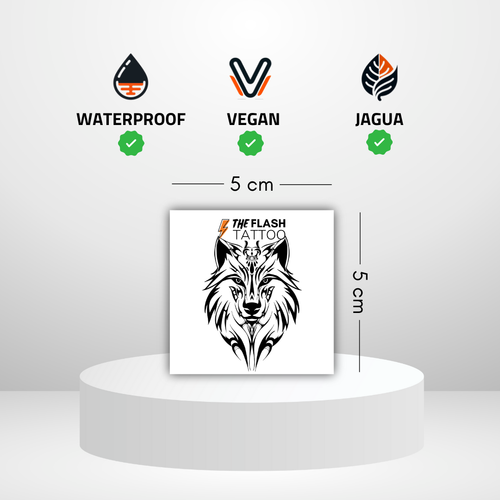
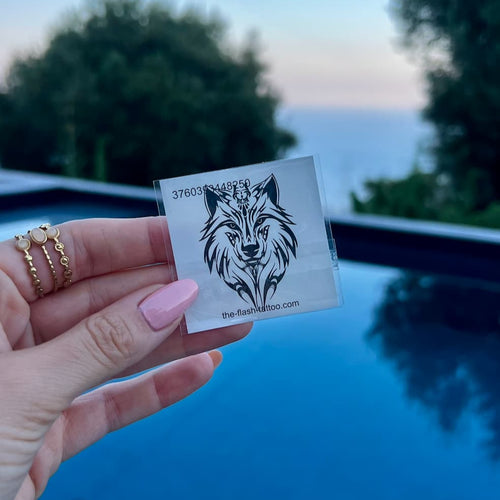


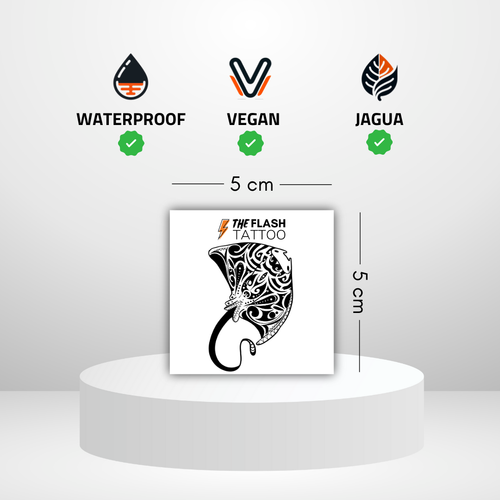
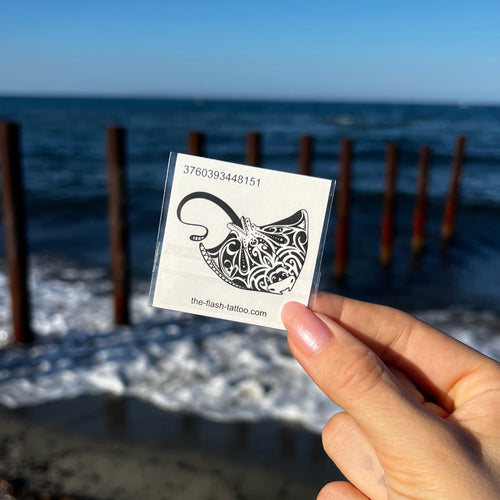
Tribal, Polynesian and Maori spine tattoos


Tribal follows the spine almost naturally: solid, symmetrical black shapes that read from a distance. The three designs in this section show three ways of approaching it.
The fishbone spine is the most direct. A central stem carries curved points on each side, angled downwards, like a fishbone. It tapers as it descends, so you can lengthen or shorten it to the height you want. The Polynesian-inspired band is built differently: horizontal strips of sawtooth patterns, waves and parallel lines, stacked in a narrow column. The Maori-inspired spiral band alternates scrolls on either side of the axis, in solid black edged with fine lines.
These pieces have one thing in common: plenty of solid black. That is an advantage for a temporary trial, since our tattoos contain no grey or gradient, only a solid line. You still need to keep gaps between the shapes: too close together, they merge into a single blotch as soon as you step back.
These designs draw on traditions with their own history. If you are aiming for a permanent tattoo in this spirit, talk to a tattoo artist who knows these styles. More pieces are gathered on the men's tribal tattoo page.
💡 Did you know?
The English word "tattoo" is borrowed from the Tahitian tatau. It appears in English in James Cook's journal, in Tahiti, in July 1769: "Tattow, as it is called in their Language".
Dragon, snake, koi and phoenix: pieces that climb


Japanese-inspired pieces tell a story of movement, and the spine gives them a ready-made path. An animal that climbs up the back gives the whole piece momentum: head at the top, between the shoulder blades, and tail trailing down towards the lower back.
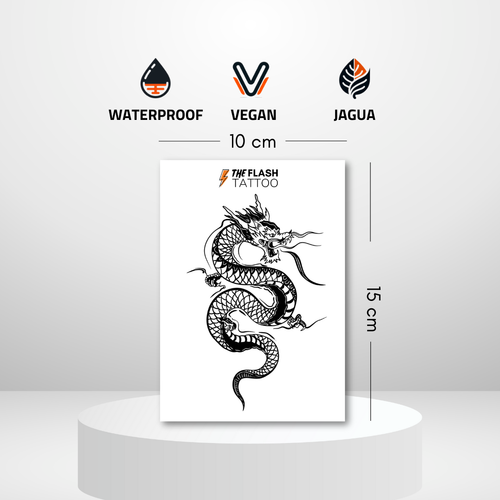
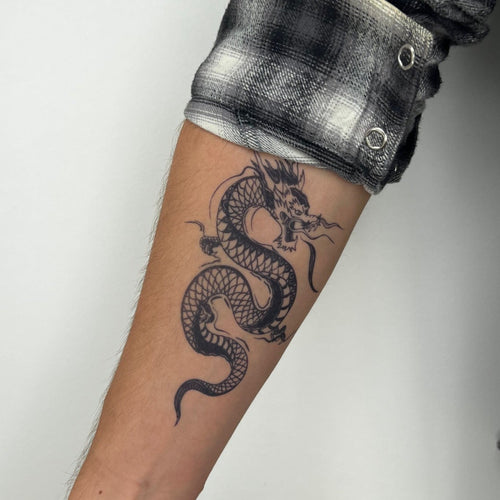
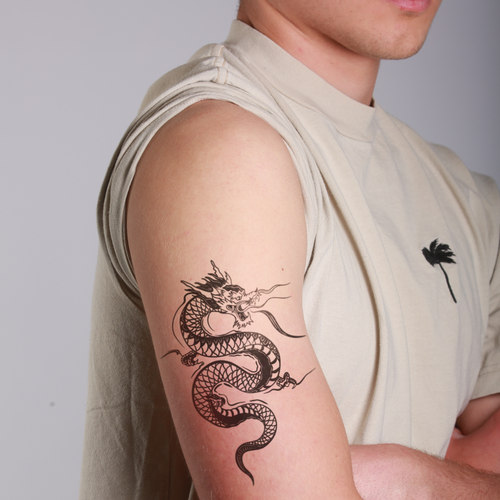
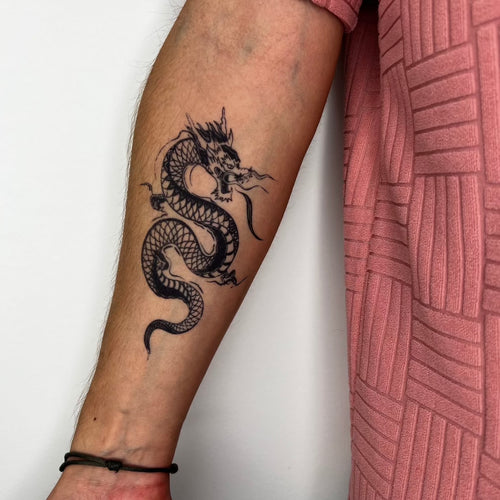
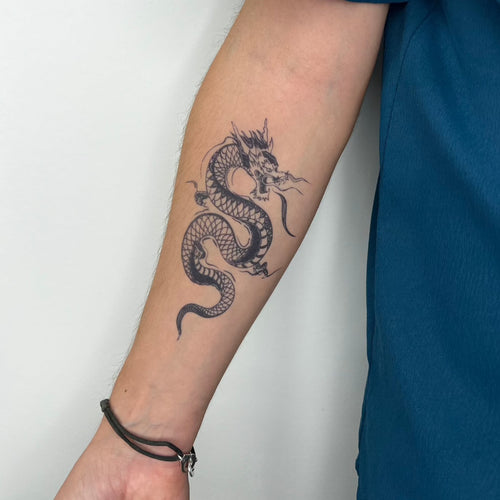
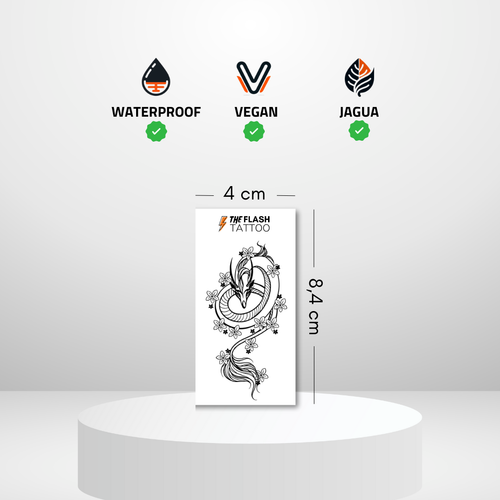
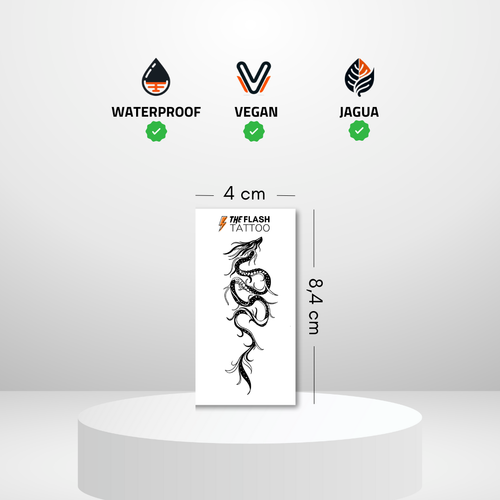
The dragon is the most spectacular of the four designs. Its body winds around the axis in tight S-curves. The scales are done in stippling and solid fills, and the claws stay folded in so the design doesn't widen. The snake takes the same idea and keeps it simpler: a single body, a head raised towards the neck and scales marked with a simple line. The koi carp swims up a cascade of stylised waves. It is the shortest piece, suited to the middle or lower spine. The phoenix has its wings folded along its body and long tail feathers that fall straight down. It keeps the vertical while adding a little width at the top.
With these pieces, orientation is decisive: head up, otherwise the animal looks as if it is falling. The longer the design, the more it comes alive on you. When you bend over, the dragon stretches; when you straighten up, it tightens. This effect works as long as the animal's body stays centred on the axis.
Dagger and sword tattoos on the spine


A blade fits the spine better than almost any other object: it is straight, narrow and pointed at one end. The ornamental dagger has a curved, scrolled guard, an engraved handle and a blade with a central fuller. Placed point down, it fills the middle of the back without spilling over. The longer cross-guard sword is surrounded by fine rays radiating from the crossguard. It draws a discreet cross between the shoulder blades, then a long blade down to the lower back.
The dagger and rose are a pairing often seen in the traditional style. The flower winds around the blade, with petals shaded in solid black and two leaves branching off to the sides. It is the only design in this section that really leaves the axis, and it works best kept small.
Two settings make the difference. The first is the point. Facing down, it follows the line of the back and lengthens the silhouette; facing up, it draws the eye towards the neck. The second is the guard, the widest element of the design. Place it on the flat part of the spine, between the shoulder blades, rather than right at the top, where the collar of your clothes rubs.
Where to place a spine tattoo, and how long it lasts
The spine isn't a single zone. The top, middle and bottom differ in width, suffer different kinds of friction and show in different ways. So before choosing a size, choose the segment.
As for wear, the spine counts as part of the back. As a temporary tattoo, expect 5 to 10 days, depending on the exact spot and how well you look after it. Our temporary tattoos last up to 2 weeks depending on the area. On the back, it is mainly chair backs, rucksack straps and belts that wear them down faster.
Upper spine, between the shoulder blades
This is the flattest and straightest part of the spine, framed by the two shoulder blades. It easily takes the widest element of a piece: the sword's guard, the phoenix's wings or the dragon's head. A compact design can also stand alone here, like the lotus mandala shown below, at 10 × 10 cm. If the design climbs up to the neck, the collar of your clothes often rubs against it. As a temporary tattoo, expect 3 to 5 days for the part on the neck. For a piece that spans from one shoulder to the other, see the men's upper back tattoo. Right next door, there are ideas for a men's shoulder blade tattoo.
Middle of the spine
In the middle of the back, the skin stretches when you lean forward and tightens when you straighten up. Pieces divided into segments, such as vertebrae, the tribal fishbone or the Polynesian band, handle this movement well: each segment shifts a little, but the whole stays legible. Our elongated 8.5 × 4 cm format, placed vertically, covers a stretch of this area. Avoid placing the widest element of the design here, as it would be the first to distort.
Lower spine, towards the lower back
Towards the lower back, the spine dips slightly between the back muscles and meets the line of the waistband. This is the natural place for the end of a design: the tip of a dagger, the dragon's tail or the roots of the tree. Trouser waistbands often rub here. Stop the design a few centimetres higher if you want it to stay crisp for longer, whether as a temporary tattoo or simply to judge how it looks. Across the full width of the back, the proportions change: see the men's back tattoo.
The whole spine, from neck to lower back
Covering the whole spine calls for a piece designed as a single block. The dragon, the tribal spine and the biomechanical vertebrae are built for this. With a needle, a piece of this length is planned with a tattoo artist, who adjusts the design to the exact length of your back. As a temporary tattoo, none of our formats covers the whole spine: the largest measures 15 × 10 cm. To judge the overall effect, line up two or three vertical 8.5 × 4 cm designs from top to bottom, then look at the result in a photo. For a woman's back, designs and proportions differ: see the women's spine tattoo. The same method applies to all tattoo placements, area by area.
Moon, mandala and geometry: circles along the axis


A series of circles lines up along the spine just like the vertebrae themselves. The phases of the moon are the most readable version: solid discs and crescents, from the new moon to the full moon in the centre and back again, linked by small dots. Placed in a column, they read from top to bottom like a cycle.
The mandala lends itself to two uses. As a set of three, from largest at the top to smallest at the bottom, it runs down the spine while narrowing, and each mandala is edged with stippled petals. On its own, as a lotus mandala, it becomes a compact piece between the shoulder blades, with solid black petals and a dotwork centre. The lotus adds a floral touch without leaving geometry behind.
Finally, the stacked hexagons trace a column of honeycomb cells shaded with stippling. The stippling is denser in the centre and lighter at the edges, which creates depth without any grey.
Geometry is unforgiving: a circle turning oval or a crooked hexagon is spotted at once. A well-centred application is half the result, and it is also the hardest part to get right alone, since you can't see your own back.
Men's spine tattoo: lettering and phrases


Vertical lettering is a understated way of filling the spine: one or two words, turned a quarter turn along the axis.
The choice of lettering changes everything. Roman capitals, like "MEMENTO MORI" turned a quarter turn along the axis, form a clean, regular column, almost architectural. Gothic, with "Invictus" written along the axis, brings thick strokes and points: the look is harder and denser. The Roman numerals of a date, here "III.XI.MCMXCII" for 3 November 1992, form a fine line made of straight strokes, read from bottom to top.
Keep the text short: beyond a few letters, vertical lettering becomes long and hard to read at a glance. Check the spelling twice. If you write a date in Roman numerals, check the conversion too, as one extra letter changes the number. If the text is in Latin or a language you don't speak, have it proofread. Finally, compare two or three lettering styles before choosing: a temporary trial shows you the word on your skin, at its real size.
Minimalist men's spine tattoo: line, arrow and tree


Not everyone wants a piece that runs from neck to lower back. A fine, short version keeps the idea of the vertical with far less ink.
The single-line arrow, fletching at the top and point at the bottom, fits in our elongated 8.5 × 4 cm format and sits between the shoulder blades. The fine fishbone takes up the tribal spine seen above, but reduced to light lines: the same structure, without the heavy black masses. The vertical tree turns the spine into a trunk. The branches open at the top, towards the shoulders, and the roots descend towards the lower back, all in fine line with a light stippling on the bark.
What makes these designs discreet isn't just their size: it is the empty space left around the line. Even placed in the centre of the back, they stay light and disappear under any T-shirt. If you can't decide between the tree and the arrow, try one then the other: one fills the back, the other punctuates it. More ideas on the minimalist men's tattoo page.
What a spine tattoo means
The meaning comes from the design, not the spine. Here are the most common readings of the designs on this page. They aren't rules: the same image doesn't say the same thing from one culture or person to the next.
- Vertebrae play on the very image of the backbone: what keeps you upright and what supports. Drawing them often amounts to displaying that idea of resilience.
- The moon and its phases evoke cycles, renewal and periods of transition. Lined up along the spine, they read as the passage from one stage to the next.
- The snake changes meaning across cultures: wisdom, rebirth or healing. Some choose it to mark the end of a difficult period.
- The phoenix, which is reborn from its ashes, speaks of getting back up after an ordeal.
- The dragon is commonly associated with strength and protection.
- The tree links roots and branches: it is often read as origins and growth.
- The dagger and rose are often read as a combination of gentleness and danger.
Choose the image that suits you first, then the segment of the spine that gives it its place. Wearing a symbol for a few days as a temporary tattoo quickly tells you whether it still speaks to you once it's on your skin.
More designs await in our tattoo ideas by motif: butterfly, rose, dragon, lettering and many more.
Test the design as a temporary tattoo before the needle
The 24 designs on this page are tattoo ideas, not products for sale. To try a vertical piece on your skin, our temporary tattoos made with jagua ink, a fruit from the Amazon, go on without a needle and without pain. The ink is vegan and PPD-free. The design darkens and develops over 24 to 48 hours, in black or dark blue depending on your skin's pH. It is water-resistant from 24 hours after application and lasts up to 2 weeks depending on the area and care; on the spine, expect 5 to 10 days.
On this area, a trial answers questions a sketch leaves open. Is the design long enough for your back? Does it stay straight when you bend over? Do you like the solid black of tribal as much as fine line? Get help with the application, since you can't see your own back, then avoid any friction for the first 8 hours. The step-by-step guide: how to apply your temporary tattoo. When you want to move on, it comes off by exfoliation: removing a temporary tattoo.
The shop offers more than 500 designs. Here are some more, available right now:


Frequently asked questions
Does it hurt on the spine?
With a needle, the spine is reputed to be sensitive: the bone sits right under the skin, with little flesh around it. The sensation varies from person to person and from one segment to another, and your tattoo artist will be able to tell you what to expect. A temporary tattoo doesn't hurt at all: no needle, and it goes on clean skin painlessly. It's a simple way to choose the design before thinking about the session.
How long does a temporary tattoo last on the spine?
It lasts 5 to 10 days, as on the rest of the back, depending on the exact spot and how well you look after it. If the design climbs up to the neck, expect 3 to 5 days for that part. The design develops over 24 to 48 hours, then wears down mainly through friction: chair backs, rucksacks, belts. Avoid any friction for the first 8 hours. Our tips for making a temporary tattoo last longer.
Which style ages best on the spine?
For a permanent tattoo, ask your tattoo artist: they know your skin and how their linework evolves. What you can judge yourself is legibility. Pieces with bold lines and clearly marked gaps, like the tribal fishbone, the dagger or Roman capitals, read from a distance. Very fine details get lost faster when the design is small. A temporary trial, at real size, shows you what stays legible when you step back.
Can you hide it at work?
Yes, easily: the spine is covered by any shirt or T-shirt. Only the top of the design can show, if it climbs up to the neck and you wear an open collar. If you need to stay discreet, stop the design between the shoulder blades, below the collar line. Conversely, a vest top or a workout will reveal it: you choose when it shows. A temporary trial lets you check what peeks out with your usual clothes.