

A men's arm tattoo is chosen in two stages: first the style, then the space it takes up on the arm. Tribal and Maori designs follow the curve of the bicep and shoulder. Japanese and realism need the length of the forearm. Lettering and small motifs slip onto the inner arm or near the wrist. Here are 40 black-line ideas, sorted by style, followed by a guide to the different areas of the arm. To try a design on your skin before you commit, take a look at our temporary arm tattoos.
Tribal and Maori arm tattoos


On the arm, tribal and Maori designs have an advantage: their shapes follow the muscle rather than sitting flat on it. The armband with sharp points wraps around the bicep, symmetrical around a central point. The hooked tribal design starts at the shoulder, wide at the top, and runs down in tapered flames to the middle of the arm. These are bold solid blocks with no shading. They read from a distance and suit temporary tattoos well, which don't do greys or gradients.
Polynesian designs are built in bands. The horizontal band stacks three rows, shark teeth, scales and waves, separated by double lines. The vertical forearm band adds spearheads and braided lines, framed by thick borders. The Maori-inspired half sleeve changes tone: spirals and double lines that open towards the shoulder, with plenty of empty space between the blacks.
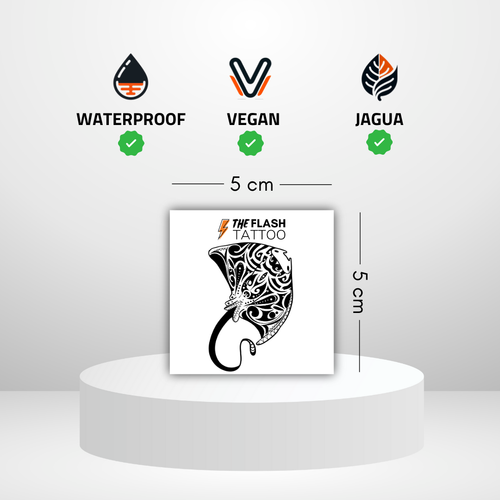
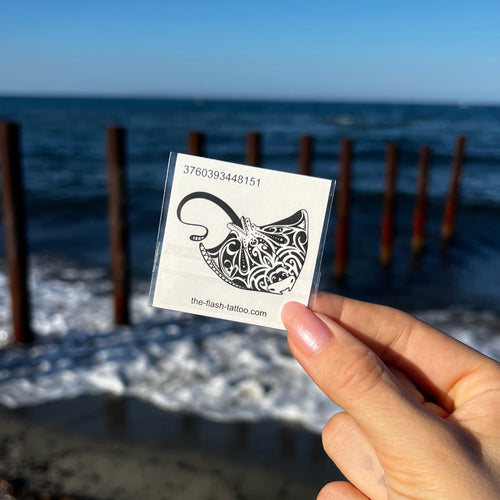
For a more figurative design, the turtle seen from above and the manta ray with open wings take this vocabulary of shapes into an animal silhouette. They sit well on the shoulder or the outer forearm. The fine tribal bracelet stays close to the wrist: a discreet way into the style.
For a men's tribal tattoo, start from the shape of the muscle rather than a flat drawing: that is what decides where the point should fall.
To judge the effect on your arm, these designs from our collection are available as temporary tattoos:






Japanese arm tattoos: dragon, snake and koi


Japanese style treats the arm as a single surface: one main subject, and a background of waves, clouds or wind that links it to the rest of the arm. The dragon climbs in coils through the clouds, with detailed scales, open claws and the head at the top of the design. The koi carp swims up the waves in the same direction. Both pieces are vertical: they need the forearm or the outer upper arm, where there is no shortage of length.
Other designs fit inside a square and can become the starting point for a sleeve. The snake coiled around an open peony raises its head, fangs bared. The tiger descends between bamboo stalks, its stripes in solid black. The hannya mask, seen from the front, shows its horns and fangs in a symmetrical composition. So does the samurai helmet, with its frontal crescent and the plates that protect the neck. Both of these read from the front and sit well on the bicep or shoulder.
The wave and cherry blossom band works as a transition: above the wrist, or to close a composition above the elbow. In pure black, Japanese style keeps its strength on one condition: replace the grey with solid blocks and dotwork. Clouds are outlined with a thick line, water is drawn in lines, and the shading on scales is built up dot by dot.
Clock, rose and compass in pure black


The clock, the rose and the compass come from realism, which is often tattooed in grey. In our designs, dotwork replaces the gradient: the tighter the dots, the deeper the shadow. The contrast stays strong and the design reads in pure black.
The clock with Roman numerals, with a rose in full bloom in front of the dial, is made for the forearm. You can set it to the time of a moment that matters. The shattered clock, whose fragments turn into swallows, says the same thing with more movement. It needs width: our largest size, 15 × 10 cm, is enough to judge it as a temporary tattoo. The open pocket watch hanging from its chain and the hourglass with its turned wooden frame are vertical and narrow. They follow the forearm or the inner arm.
The compass, with its sixteen-point compass rose and graduated ring, reads best when flat. Place it on the upper forearm or on the bicep, centred on the widest part. The single rose on its long thorny stem is the most versatile design in the series. It goes with a clock, a compass or lettering, or can be worn alone above the wrist.
Lion, angel and religious motifs


A powerful animal or a religious figure, treated like a portrait: this is the other big family of men's arm tattoos. The lion is the classic example. Crowned and seen from the front, it looks straight ahead. Its mane in fine lines and dotwork frames the face, and the crown gives a vertical axis that sits well on the shoulder or bicep. The roaring lion in profile has more movement: place it so that it faces towards the front of the arm, not towards the back.
Religious figures follow the same logic. The praying angel with folded wings and the archangel raising his sword with wings spread are drawn like statues: drapery in lines, shadows in dotwork, as if carved in stone. The clasped hands around a rosary and the face of Christ crowned with thorns sit better on the forearm, at eye level.
In a portrait, whether human or animal, the eyes are what count. If they are badly placed on the curve of the arm, they make the face look lopsided. A temporary trial lets you check this in front of a mirror, with your arm straight and then bent.
💡 Did you know?
Pazyryk kurgan 2, in the Altai, was excavated by Sergei Rudenko in 1947. It held a Scythian chief from around 300 BC, whose arms, shoulders and chest bear animal-style tattoos. It is now kept in the Hermitage Museum.
Old school tattoos: anchor, swallow, dagger


Old school comes down to three principles: a thick outline, solid black fills and little detail. It reads from a distance and stays crisp at a small size. The anchor wrapped in rope, the pair of swallows facing each other and the dagger piercing a heart with drops at the tip are the classics. Each fits on a forearm. You can combine them to fill the arm piece by piece, with no overall plan, leaving bare skin between them.
The ace of spades, set in front of a fan of cards, plays on chance. The skull with a snake passing through it sets bone, shaded with dots, against the animal's scales. The black panther, claws forward and mouth open, is a vertical design: placed along the length of the forearm or bicep, it seems to climb up the arm. Its body is a large block of black, where the highlights are left bare, with no ink.
Lettering and dates on the arm
Lettering finds its place on the forearm and inner arm, two long, flat areas where letters distort very little. “Memento mori”, in gothic lettering, sits horizontally; the Latin phrase means “remember that you must die”. The date “MCMXCV”, in Roman capitals, corresponds to 1995. Its letters are stacked to read from top to bottom, on the inner arm. “Famille”, in cursive, has a more fluid line that follows the curve of the forearm.
Before choosing the word, choose the reading direction. Facing you, it is you who reads it; facing outwards, it is other people. Have any text in a foreign language proofread, and double-check the conversion of a date into Roman numerals. Finally, keep the text short: our elongated 8.5 × 4 cm format is enough for a word or a date.
Geometric, mandala and fine designs


Geometric style is all about precision: regular, repeated shapes, with dotwork to give volume. The band of hexagons and triangles stretches along the forearm or serves as a background for a future sleeve; some shapes are filled in with dotwork, others left as outlines. The perfectly circular mandala opens out into pointed petals and rings of dots. It is designed for the elbow, where its round shape follows the joint.
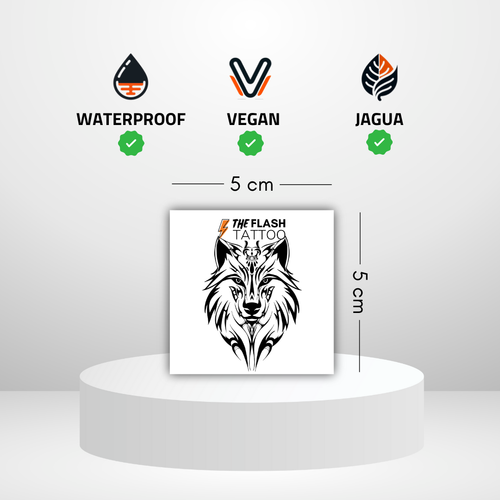
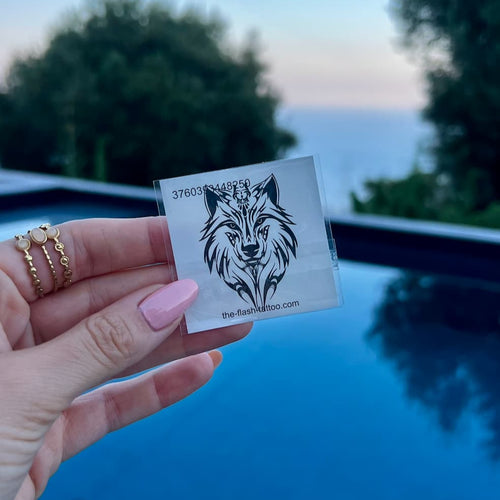
For a lighter style, two designs stay small. The bracelet of double lines, punctuated with small diamonds, accentuates the wrist. The faceted wolf head, built from straight lines, fits within 5 × 5 cm. They suit a first tattoo, or a design that a shirt sleeve is enough to hide. A men's minimalist tattoo rests on the same idea: few lines, each in its place.
Meaning of arm tattoo motifs
The same design doesn't mean the same thing to everyone. Here are the most common readings of the motifs on this page: guidelines, not rules.
- The lion: strength, courage, protecting your loved ones; crowned, it also suggests authority.
- The dragon and the tiger: power and protection, two frequent readings in Japanese tattooing.
- The koi carp: perseverance, because it swims against the current instead of following it.
- The snake: transformation and renewal, since it sheds its skin.
- The clock, the watch and the hourglass: the passing of time, or a specific moment you want to keep.
- The compass: direction, travel, the wish not to lose your way.
- The anchor and the swallow: stability and return, two ideas often associated with old school.
- The rose: love; with its thorns, the idea that what matters comes at a price.
- The angel, clasped hands and rosary: faith, protection, or a tribute to a loved one who has passed.
- The skull and “Memento mori”: the awareness that life is short, and the desire to make the most of it.
- Tribal, Maori and Polynesian: these designs come from cultures where shapes carry meaning. Find out about their origins, and talk to your tattoo artist, before making one a permanent tattoo.
Time remains the best test: a symbol you still like after a few days on your skin has a good chance of being the right one.
Where to place it on the arm, and how long it lasts
The different areas of the arm don't have the same shape, the same visibility or the same sensitivity to the needle. As temporary tattoos, ours last up to 2 weeks depending on the area and aftercare. On the arm, expect 5 to 10 days. Towards the hand, the skin rubs and is washed more often: on the wrist, fingers and back of the hand, wear time drops to 3 to 7 days.
The duration depends on the exact spot and on aftercare, starting with 8 hours without rubbing after application. A women's arm tattoo follows the same logic of zones, with different proportions and different designs. The same method applies to all tattoo placements.
Forearm
Very visible with your sleeves rolled up, hidden under a long sleeve: the forearm shows itself when you decide. Its outer side, long and flat, takes the vertical pieces on this page: dragon, koi carp, clock, Polynesian band. It is reputed to be less sensitive than the inner side. It's also an easy area for a first men's forearm tattoo as a temporary tattoo: you can see it, so you can apply it yourself. Near the wrist, wear time drops to 3 to 7 days.
Bicep and shoulder
The outside of the bicep offers a round, fleshy surface, reputed to be low in sensitivity, which a T-shirt sleeve hides in whole or in part. Designs that read from the front belong here: crowned lion, samurai helmet, compass, Polynesian turtle. The tribal armband and the Polynesian band wrap around it, and the hooked tribal design runs up to the shoulder. For a men's bicep tattoo, centre the design on the muscle with your arm relaxed, then check how it looks with your arm flexed.
Tricep and inner arm
The tricep, at the back of the arm, is mostly seen from behind: a men's tricep tattoo is made to be seen by others, and for applying a temporary one, it's better to get some help. The inner arm, by contrast, stays hidden as long as your arm is by your side, and is revealed when you lift it. The skin there is thin and reputed to be sensitive to the needle. It suits narrow designs: the date in Roman numerals, the hourglass, the rose on its stem. A men's inner arm tattoo is still easy to hide day to day.
Elbow
The elbow is a joint: the skin folds, stretches and passes directly over the bone. It is reputed to be a very sensitive area for a needle tattoo. Round designs work better there than others, because they follow the point of the elbow instead of folding in half. The mandala on this page is designed for exactly that. For a men's elbow tattoo, centre the design on the point with your arm bent, then check that it stays legible with your arm straight.
Sleeve, half sleeve or full arm
The half sleeve covers one half of the arm, from shoulder to elbow or from elbow to wrist. The sleeve and the full arm run from shoulder to wrist. The Japanese pieces, the Maori half sleeve and the geometric band on this page are designed to extend into one. A men's half sleeve tattoo can later become a men's sleeve tattoo: the starting design must leave room for what comes next. A men's full arm tattoo is generally done over several needle sessions.
As temporary tattoos, our sizes go up to 15 × 10 cm. They don't cover an arm, but two or three designs placed where they would go give you an idea of the whole. Beyond the wrist begins another area, with its own constraints: the men's hand tattoo.
More designs are waiting for you in our tattoo ideas by motif: butterfly, rose, dragon, lettering and many more.
Trying your design as a temporary tattoo before the needle
The 40 designs on this page are ideas, not products for sale. To judge a design on your own arm, our temporary tattoos use jagua ink, from an Amazonian fruit. They are vegan, PPD-free, and applied without needles or pain. The design darkens and develops over 24 to 48 hours, black or dark blue depending on your skin's pH. It is water-resistant from 24 hours after application and lasts 5 to 10 days on the arm, depending on the spot and aftercare.
These few days answer questions that no sketch can settle. Does the design keep its shape when the muscle is working? Is it too visible, or not visible enough, with your sleeves rolled up? For a planned sleeve, apply two or three designs in their intended places and look at the whole in a mirror. That is what a men's temporary arm tattoo is for: deciding on the skin rather than on a screen.
Among our 500+ designs, others are available right now:
 Lion tattoo
 Clock of yesteryear
 Angel tattoo
 Prayer sleeve
 Swallow
 Infinite anchor
 Shadow dragon
 Viking sleeve
Frequently asked questions
Does it hurt on the arm?
With a needle, it all depends on the area. The outside of the bicep and the forearm, which are fleshier, are reputed to be low in sensitivity. The elbow, which passes over the bone, the inner arm and the wrist, where the skin is thin, are reputed to be more sensitive. A temporary tattoo, on the other hand, is applied without a needle and without pain: it's a simple way to test a design before booking an appointment.
How long does a temporary tattoo last on the arm?
On the arm, expect 5 to 10 days, and 3 to 7 days on the wrist or the back of the hand. In general, our temporary tattoos last up to 2 weeks, depending on the area and aftercare. Avoid any rubbing for the 8 hours after application; the design is then water-resistant from 24 hours after application. The step-by-step guide: how to apply your temporary tattoo. Our tips for making a temporary tattoo last longer.
Which style ages best on the arm?
There is no universal answer: ask your tattoo artist, who knows their technique and your skin. You can, however, judge legibility yourself. A clean outline, as in old school or tribal, reads from a distance. A very detailed design, shrunk to a small size, quickly becomes muddled. A temporary tattoo doesn't show how a tattoo changes over the years, but it does show whether the design stays legible at its real size, on your arm.
Can you hide it at work?
Yes, depending on the area. The upper arm, bicep, tricep and shoulder, is largely covered by a T-shirt sleeve. The forearm hides under a long sleeve, and the inner arm stays hidden as long as your arm is by your side. The wrist is trickier: a watch or a shirt cuff doesn't always cover it. With a temporary tattoo, the question doesn't stay with you for long: the design lasts a few days and comes off with exfoliation. All the methods: removing a temporary tattoo.